
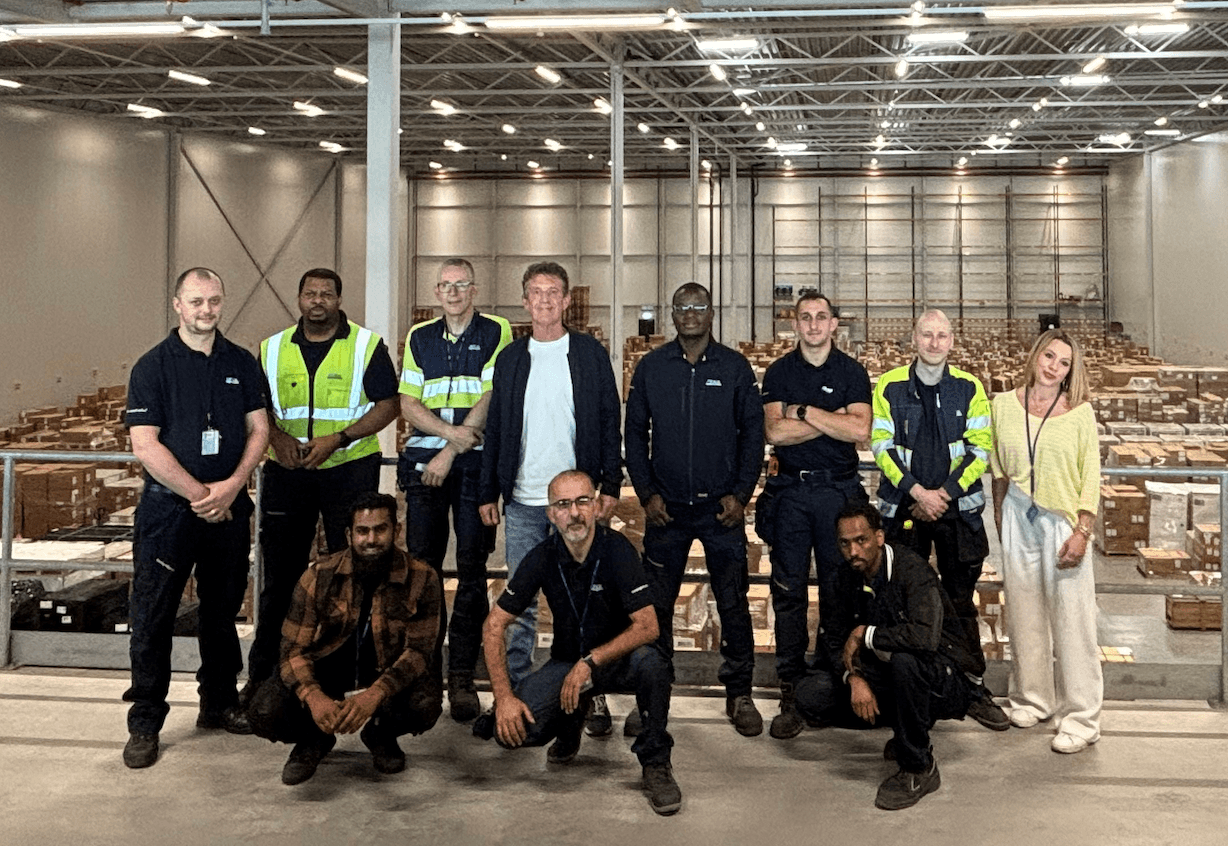
We have been putting this into practice for Flexport for several years now. From our site in Rozenburg, a dedicated team works daily on the logistics operations for Flexport and its customers. Since January 2026, we have been doing this from a new warehouse of approximately 4,000 m², close to Schiphol and the A4 motorway, marking the start of a new phase in our partnership.
What do we mean by dedicated warehousing?
With dedicated warehousing, we set up a warehouse operation specifically for a single client. We tailor the staff, processes and facilities to that organisation’s goods flows and operational requirements.
The key difference from a standard warehouse environment is that our dedicated team works with the same operations, processes and client agreements every day. As a result, our colleagues build up an ever-increasing level of knowledge about the goods flows and the specific requirements associated with them.
For Flexport, we carry out a wide range of activities from our Rozenburg site. We process import freight, prepare air freight pallets for export, unload sea containers and handle tasks including pick and pack, sorting and order processing at item level. Specific tasks such as inspections, photography and packaging instructions are also part of our daily operations.
Hans Jouta, who is in charge of operations, sees this very versatility as characteristic of what goes on in Rozenburg: “With a relatively small team, we carry out a very wide variety of tasks here.”
A permanent team that knows the operation inside out
A key strength of our dedicated approach lies in the knowledge built up within the team. A large proportion of the permanent core staff have been working together since the operation first began. As a result, our colleagues are not only familiar with the processes, but also with many specific instructions and requirements from Flexport and its customers.
Hans sees the benefits of that experience every day: “For most shipments, my team already know exactly what needs to be done. They recognise the customer and know, for example, how something should be packed, what they need to check and when photographs need to be taken.”
That knowledge is therefore not confined to systems and work instructions. It is also embedded in our staff’s day-to-day experience. When dealing with recurring goods flows and customer-specific tasks, this helps them to act quickly and independently.

A solid foundation with scope for expansion
For us, a dedicated operation does not mean that everything is always the same scale. Goods flows change, volumes may increase and projects may temporarily require extra capacity.
That is why we work with a core team of experienced colleagues and can add extra capacity where necessary. New or temporary staff work alongside colleagues who are already familiar with the operation and can help them get to grips with the existing working methods.
A good example of this was a project to fit out hotels in Paris. Various goods were received by us, sorted and prepared for each hotel room before being transported onwards. For a project like this, we were able to temporarily deploy extra staff alongside the existing team. Hans explains: “Suddenly it gets very busy and I need three or four extra people.”
This is how we combine continuity with flexibility: a permanent core team that knows the operation, with the scope to adapt when the flow of goods requires it.
‘Dedicated’ does not mean operating in isolation
Although our site in Rozenburg is entirely geared towards Flexport’s operations, the warehouse is not separate from the rest of Bos Logistics.
For transport to and from the airport and onward distribution, we work together with other teams within our organisation. This enables us to link what happens in the warehouse directly to other parts of the logistics chain.
For Flexport, this means that a dedicated team manages its own operations on a daily basis, whilst the wider Bos logistics organisation is also available to support them.
It is precisely this connection that we consider important. We look not only at what happens within the warehouse walls, but also at the link to transport and the next stage in the flow of goods.
A partnership built on trust
When you’re responsible for a client’s day-to-day operations, it requires close collaboration and trust.
Hans and his team deal with Flexport’s goods flows on a daily basis. At the same time, Hans maintains regular contact with Flexport’s management. The day-to-day warehouse operations are largely carried out independently by our team.
After nearly five years of working together, Hans says a great deal of trust has developed: “It’s simply become a matter of trust.”
You don’t build that trust overnight. It develops by getting to know each other and the operations better and better, honouring agreements, retaining knowledge and finding solutions together when practical circumstances require it. In this way, a dedicated warehouse can increasingly function as an extension of the client’s logistics organisation.

A new location for the next phase
Since January 2026, we have been running our operations from our site in Rozenburg. The warehouse covers approximately 4,000 m² and is situated close to Schiphol and the A4 motorway.
The move coincided with a new five-year partnership agreement with Flexport. This marks the start of the next phase in a partnership that has now been in place for several years.
From this location, our team has a permanent base for the various goods flows and activities that come together within the operation.
When is dedicated warehousing a viable option?
Dedicated warehousing can be a viable option when goods flows are sufficiently regular and the operation requires specific processes, expertise or capacity.
Our partnership with Flexport clearly demonstrates how such a model can work in practice. A warehouse organised around the customer’s operations. A permanent core team of colleagues who are constantly gaining a deeper understanding of the processes and specific requirements. The flexibility to adapt as volumes or workloads change. And the rest of our logistics organisation right behind them.
For organisations that do not wish to organise their warehouse operations entirely in-house, but do need a team and working method that are genuinely tailored to their own operations, this can be an attractive solution. We handle the day-to-day execution and management, whilst processes, capacity and tasks are tailored to the requirements of the operation.
And if that demand changes – for example, due to growth, seasonal peaks or a new project – the operation can adapt accordingly without the customer having to set up a new logistics structure from scratch every time. Ultimately, for us, dedicated warehousing is about much more than just square metres of storage space.
It is about a logistics operation that we build up together with the customer, getting to know it better and better and continuing to develop it. With the attention and accumulated knowledge of a dedicated team, the ability to adapt to practical circumstances, and the broader logistics organisation of Bos Logistics behind it.