
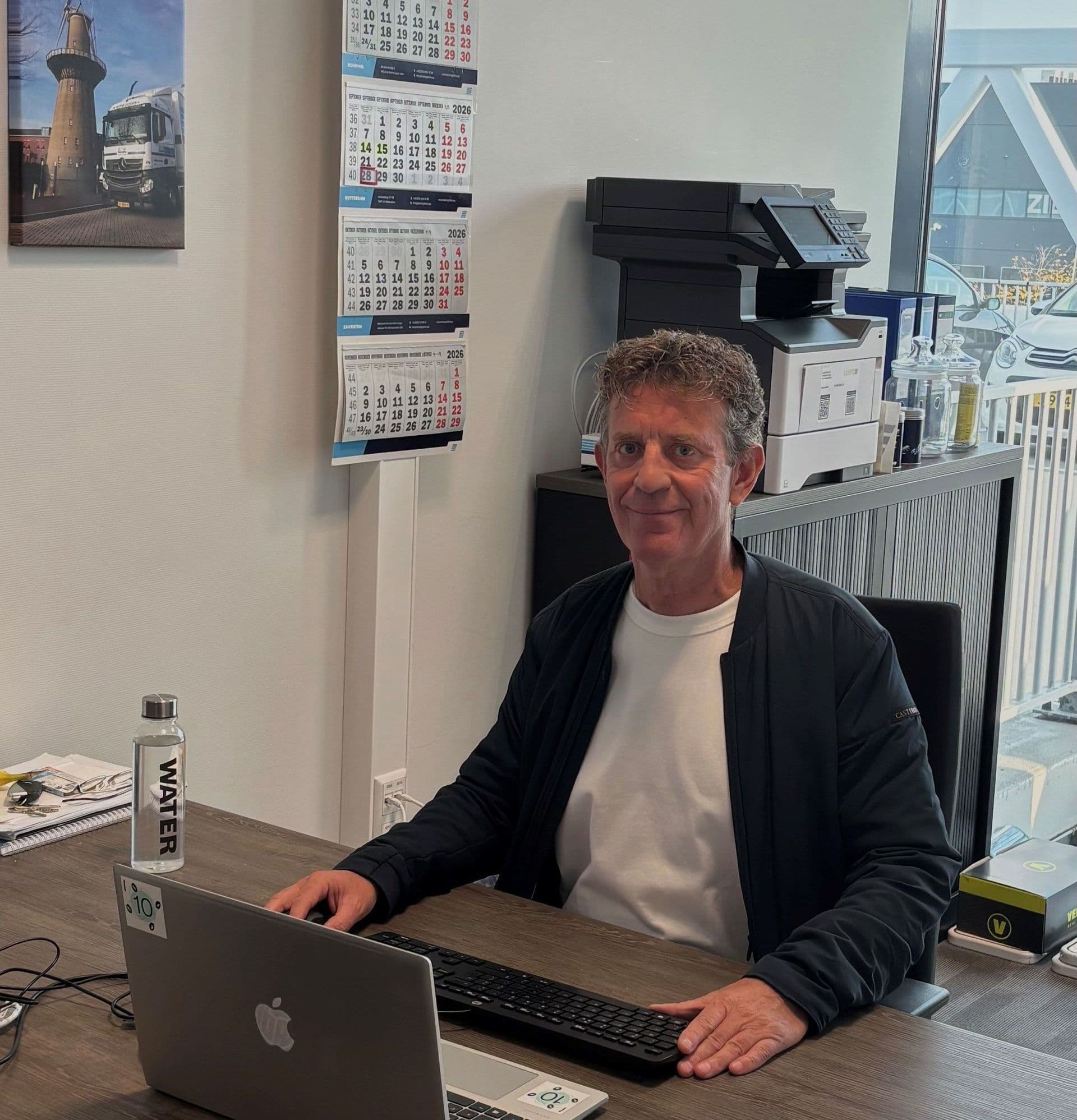
At the age of 23, Hans Jouta started working as a courier at Schiphol. Almost 37 years later, the airport is still an important part of his working life. In the intervening years, he has seen logistics from various perspectives: from courier and customs agent to branch manager at a freight forwarder and, ultimately, head of a dedicated warehouse operation at Bos Logistics.
And Bos Logistics? He’d known about them long before he started working there himself. “At my previous employer, we were a client of Bos. We were actually the first to outsource our freight handling to them in this way.”
In this edition of ‘Bos Behind the Scenes’, we get to know Hans. We’ll hear about his long career in logistics, the transition from client to colleague, his management style, and why, after all these years, he still derives great pleasure from a team that takes responsibility together.
From courier to branch manager
Hans began his career at Schiphol as a courier. He then joined a freight forwarder and started working as a customs agent, dealing with customs matters.
What followed was a career spanning more than three decades on the freight forwarding side of the air freight industry. Hans spent seven years working in an American-owned organisation and subsequently 25 years with a freight forwarder of Japanese origin. During that time, he rose through the ranks to become branch manager, amongst other roles.
During that period, he knew Bos Logistics from a completely different perspective: as a client. When his employer at the time decided to outsource part of its logistics operations, freight handling was entrusted to Bos. As a result, Hans found himself on the other side of the table for many years.
After 25 years with the same employer, he eventually decided to take a new step. This time, not to another freight forwarder, but to Bos Logistics: “After 32 years purely on the freight forwarder’s side, that was quite a change. I suddenly found myself working for a Dutch transport company. I was already familiar with Bos, of course, but it’s a completely different ball game.”
Suddenly on the other side of the table
Hans started at Bos Logistics as a project and process manager. Not long after, he became heavily involved in the Flexport operation.
What began as a role as the permanent operational point of contact developed into responsibility for setting up a fully dedicated warehouse. Hans was involved in fitting out the site, recruiting staff, purchasing equipment and everything else needed to get the operation up and running.
He has now been working closely with Flexport for almost five years. Since early 2026, this has been based at a site in Rozenburg, where a team of around fourteen colleagues on average handles a wide range of logistics tasks seven days a week.
Because of this close collaboration, Hans finds himself in a unique position: “I have to say quite honestly that, in a positive sense, over the course of those nearly five years, I have sometimes become more of a Flexport employee than a Bos Logistics employee. I simply have a great deal of contact with them and handle their operations on a daily basis.”
That doesn’t mean Hans doesn’t feel part of Bos Logistics. Above all, it says something about what he believes dedicated work actually entails: being close to the customer and taking responsibility as if it were your own operation.
Trust is built up over the years
That responsibility goes beyond simply carrying out logistical tasks. Flexport itself has only a limited physical presence at the site. Hans is in weekly contact with the management, whilst his team largely carries out day-to-day operations independently. “It’s simply become a matter of a great deal of trust.”
That trust is also evident on the shop floor. A significant proportion of his team has been working within the same operation for years. As a result, staff are not only familiar with the processes, but also with many specific customer agreements.
“My team know exactly what needs to be done for certain consignments. They recognise the customer and know, for example, how something should be packed, what they need to check and when photographs need to be taken.”
Hans is proud of that stability. He explains that there is little staff turnover within his core team and that several employees have been part of the team since the days at the previous site.
For him, that’s no coincidence. According to Hans, the way you treat people has a direct impact on how a team functions.
“You have to do it together”
After decades in managerial roles, Hans has developed a clear view on leadership. Shouting, putting people in their place or constantly emphasising hierarchy have no place in it.
“We’re all equals here. One person is a supervisor, another a team leader, but you have to do it together as a team. We really do it as a group, together.”
Hans therefore tries not just to tell staff what they can and cannot do. Above all, he wants to make it clear what effect their actions have on others. This is characteristic of the way Hans tries to lead. Not acting as a manager who merely corrects, but helping people understand what their behaviour means to others.
The consequences often fall on your colleague
That idea crops up frequently in his way of working. When someone fails to keep an appointment, Hans tries to make the consequences clear. Not in terms of what it means for him as a manager, but in terms of the consequences for colleagues.
“Ultimately, that doesn’t affect me. At the end of the day, I get into my car and go home. But perhaps because of that, your colleague will be sweating it out in that warehouse for another three hours.” For Hans, therefore, responsibility also means taking the people around you into account.
Perhaps that partly explains why he is so proud of the core team that has developed over recent years. Experienced staff know the business inside out, help new colleagues settle in and know they can rely on one another.
A new chapter
After nearly 37 years in logistics, Hans has built up a wealth of knowledge and experience. The vast majority of his time, attention and energy is devoted to the dedicated operation for Flexport, for which he is responsible on a day-to-day basis. Drawing on this experience, his insights are occasionally called upon in other areas within Bos as well.
For example, Hans has recently become involved in claims received via freight forwarders relating to air and sea freight, such as in cases of damage or loss. His expertise can also be valuable in new initiatives concerning dedicated warehousing. Plans are currently being developed for a similar dedicated operation for another client. Drawing on his knowledge and experience, Hans could, for instance, provide advice or guidance on the organisation and approach.
His responsibilities at Flexport always come first. That is where his day-to-day role lies and where his focus is directed. He sees the fact that his experience can also be of value elsewhere within Bos at specific times as a welcome addition. One thing is certain for him, at any rate: “I really enjoy what I do and I want to keep doing it.”
Alongside his work, Hans makes a point of setting aside time for completely different activities that give him energy and bring him joy. He lives near the Nieuwkoopse Plassen, enjoys spending time outdoors with his dog, and likes to go cycling or boating in his spare time.
This has naturally led to a new chapter for Hans: he is fully involved in Flexport’s day-to-day operations, whilst also having the opportunity, at specific times, to share the knowledge and experience he has built up with the wider organisation.
From Schiphol to the Nieuwkoopse Plassen
Hans likes to spend that weekend outdoors. He lives near the Nieuwkoopse Plassen and enjoys cycling or boating in his spare time. His dog also ensures he gets out and about regularly. For someone who spent a large part of his working life amidst freight, warehouses and the hustle and bustle of Schiphol, it’s a lovely contrast.
Moreover, after nearly 37 years in logistics, Hans no longer feels the need to prove himself through yet another job title. He has a business he’s proud of, a team that has been working together for years and a client relationship that has continued to grow.
And perhaps his own management style ultimately says the most about what he values after all these years: “You have to do it together.”