
In a previous article, we explained how data, technology and specialist knowledge have come to play an increasingly important role within Bos Logistics. But ultimately, for the customer, one question matters above all else: how does this manifest itself in day-to-day logistics?
Nowadays, a vast amount of information lies behind every physical consignment. Transport orders, loading details, statuses, documents, stock data, waiting times and delivery information must all be available at the right time – not only for our own staff, but also for customers and other parties in the supply chain.
If that information is incorrect or shared too late, it has a direct impact on operations. That is why we have been making targeted investments in our digital development for several years now. Drawing on specialist knowledge in the fields of data, IT and logistics processes, we are connecting systems and information to day-to-day operations in ever smarter ways.
Fewer phone calls, less manual work, fewer errors
One of the biggest changes is the way in which our systems and those of our customers communicate with one another. Digital interfaces enable orders and other information to be exchanged automatically, without staff having to manually enter the same data time and time again.
Michael van Leeuwen, who is closely involved in the digital development at Bos Logistics, sees a clear difference compared with a few years ago. “Fewer phone calls, less manual processing and fewer errors. But also greater traceability and faster feedback to customers.”
The impact of this is greater than it might seem at first glance. Every manual transfer takes time and, moreover, presents an opportunity for information to be entered incorrectly. When systems communicate directly with one another, a transport order can be processed automatically and relevant status information can then be sent back digitally.
For customers, this primarily means a faster and more reliable process. Information needs to be requested less often, and staff on both sides spend less time on administrative tasks.
Faster responses when needed
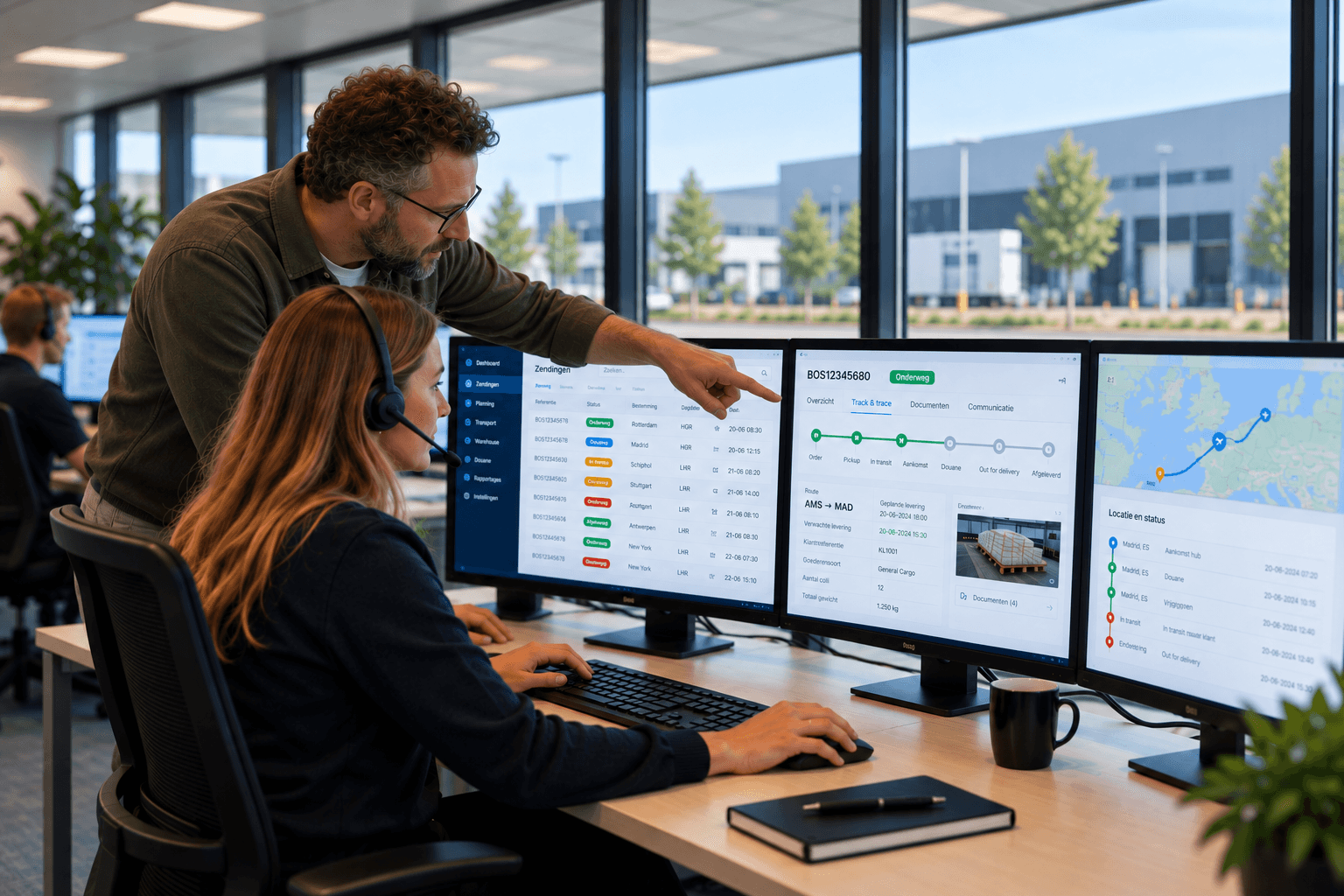
Internally, too, we are working to bring together information from different sources more effectively. At Schiphol’s Customer Service department, for example, a ticketing system has been implemented that brings relevant data from various systems together in one place. When an enquiry comes in, this means an employee does not first have to consult multiple systems separately to piece together the full picture.
This is particularly valuable when things do not go to plan. In logistics, not every deviation can be prevented. A delay, a missing reference or an unexpected situation can always arise. The difference then lies in how quickly it becomes clear what is going on and how quickly action can be taken.
Digitalisation should therefore not only ensure that everything runs more quickly when the process goes according to plan. It is precisely when something goes wrong that better information helps our staff to adapt more quickly and provide customers with more targeted support.
First time right: prevention is better than cure
Even better than rectifying a mistake quickly is preventing it from happening in the first place. That is why the ‘first time right’ principle plays a key role in the further development of our processes.
If an order is not entered fully or correctly at the outset, that discrepancy often has knock-on effects. The operations team has to correct the information, Customer Service may receive enquiries, and ultimately the finance department may also have to deal with the same error. In practice, this can mean that a single order has to be reviewed or amended several times.
That is precisely what we want to avoid as much as possible. By checking data more intelligently, integrating systems more effectively and further automating processes, information can be recorded correctly earlier in the process. This means less corrective work for our staff and a more predictable process for the customer.
From reacting to looking ahead
The next step is not only to process information more quickly, but also to use it sooner. The On Air project is a good example of this.
By gaining access to information from the logistics chain at an earlier stage, our staff can, in certain situations, take action even before the next step has formally begun. For example, if it becomes apparent that goods are about to arrive at a warehouse, arrangements can be made in advance as to where they should be prepared, and a driver’s deployment can be planned accordingly.
Michael sees this as a significant shift. Whereas Bos Logistics used to rely more on the moment an order actually arrived, operations are increasingly able to look ahead and act proactively.
This is also changing communication with customers. Information is no longer used merely to report what has happened, but increasingly to determine what is going to happen. Particularly in a logistics environment where speed and flexibility are key, this can make a significant difference.
From tracking shipments to improving processes
At the same time, more digital information ensures better traceability. Data that used to be scattered across telephone calls, messages and various systems is increasingly being recorded digitally and consolidated.
This enables us not only to track a current consignment, but also to analyse more effectively how the process unfolded. Where did delays occur? How long did a particular process step take? Which anomalies recur most frequently, and where are there opportunities for structural improvement?
We use this information in dashboards, reports and KPI analyses. In this way, data not only helps with today’s shipment, but also enables us to identify patterns and further optimise processes in collaboration with our customers.
Even the day-to-day details are going digital
Digitalisation isn’t just about large systems or complex integrations. It is precisely in everyday processes that there are many opportunities to make information available more quickly and reliably.
One example is the recording of waiting times. When a driver has to wait at a loading or unloading address, that information is relevant to various parties. We are therefore investigating how this process can be further automated, including through the use of location data. This reduces the need to manually collect information retrospectively and provides a more accurate picture of what is happening in the operation.
Documents are also increasingly becoming part of the digital supply chain. With the e-CMR, the electronic consignment note, information can be processed digitally and made available. This reduces paper usage, but above all ensures greater speed, clarity and traceability. Documents are easier to retrieve and relevant information can be shared more quickly with the parties involved.
These may be less obvious forms of digitalisation, but it is precisely these kinds of improvements that make a big difference in day-to-day operations.
More automation, more scope for personal contact
The fact that more and more information is being processed automatically does not mean that personal contact is becoming less important. On the contrary. When staff spend less time retyping data, looking up information and making avoidable corrections, there is actually more scope for tasks in which human knowledge and experience make all the difference.
Assessing an unexpected situation, helping to devise a solution, advising a customer or adapting quickly when things do not go to plan: not every logistics situation can be anticipated and captured in a system in advance. Flexibility and personal contact therefore remain a key part of good service provision.
Above all, digital solutions should help our staff to do their jobs better and access the information they need more quickly.
The next step: looking further ahead
Digital development does not stop at interfaces, dashboards or electronic documents. We are continuing to work on, amongst other things, the automation of planning, ‘first time right’, paperless processes and new applications of artificial intelligence (AI).
Whilst the technical possibilities are constantly expanding, the benchmark remains practical. An application must solve a specific problem, help prevent an error, make information available sooner or demonstrably improve a process.
For customers, this development must ultimately be most noticeable in the quality of our service: fewer manual steps and corrections, a quicker response when issues arise, better traceability and more up-to-date information on which to base decisions.
The underlying trend is perhaps even more important. We want to become less and less reliant on information that only becomes available after the event, and to know earlier and earlier what is happening in the logistics chain. Because the sooner the right information is available, the sooner we can act and the more control our customers gain over their logistics.